
There’s nothing quite like a weekend getaway. It’s quick, out the door on a Friday and back before Monday even shows up, but it does more for you than trips twice its length sometimes. Getting out of the house, out of the same four walls and the same routine, breaks up the monotony of the work week in a way that’s hard to explain until you’re actually doing it. You don’t need two weeks and a packed itinerary. You just need somewhere worth driving to and this weekend we had it all planned out.

Nashville is a quick and great weekend getaway destination for anyone in the Southeast. Friday morning came and we were excited about the trip we had planned, so we hit the road.
Once in town we checked into the Thompson Nashville, right in the heart of the Gulch. This wasn’t our first stay, it’s become one of our favorite hotels in the city, and it’s easy to see why. Opened in 2016, the hotel’s 224 rooms lean mid-century modern, which we love, floor to ceiling windows, hardwood floors, and a lobby floor inlaid with a compass mosaic marking the hotel’s exact coordinates.


The location does a lot of the work on a trip like this too, it’s an easy walk to just about everything downtown. We had reservations at Marsh House, the hotel’s restaurant, on our last visit we had the best Fried oysters of our lives. This time no oysters on the menu, the have seasonal menus and it is always excellent.


After dinner, we walked over to Pullman Standard for a nightcap. The walk took us past Union Station’s old tower still standing watch over Broadway the way it has since 1900, even though the last train left its platform decades ago.
Pullman Standard sits tucked inside the historic Cummins Station building, built in 1906 as a warehouse for unloading freight off the trains that once ran through the neighborhood. The bar takes its name and its whole atmosphere from the golden age of Pullman sleeper cars, exposed brick, leather chairs, Art Deco touches, and menus bound in leather and brass that make you feel like you’ve stepped backward a century. Ginger ordered one of their train inspired cocktails, I just had a beer from one of the local Breweries.


The walk back was pleasant, the heat of the day had lifted and nothing left was a slight warm breeze blowing. The sun setting gave a nice glow contrasting with the lights of downtown, I love the evening light right before dusk, the way everything looks with the shadows and street lights.

The next morning started slow with breakfast at the hotel before we headed out to the Frist Art Museum, catching International Surrealism from Tate: Fifty Years of Dreams, on loan from the Tate in London. The exhibit traces the long reach of surrealism as a way of thinking, not just a painting style, spanning a century of work from artists including Salvador Dalí, René Magritte, Joan Miró, Louise Bourgeois, and Dorothea Tanning. The show leans into dreams, desire, and the strange, mysterious pull of the natural world.


Something that I absolutely loved was a piece we hadn’t planned on, Intersections, a laser-cut steel light installation by Pakistani American artist Anila Quayyum Agha, part of her career retrospective Interwoven. The piece is a single suspended cube, intricately cut with a symmetric, star-and-hexagon pattern, lit from within so the design projects outward across the entire room, walls, ceiling, floor, all wrapped in shifting shadow and light. I love symmetry, and this piece showcases just that. Standing inside the room while the whole space glows and shifts around you is the kind of thing photos don’t quite capture.


From there, we still had some time before we had to be at Cheekwood so we walked Nashville’s famous strip on Broadway before looping back through Union Station on our way back to the hotel. The Gulch before it was rooftop bars and boutique hotels, it was Nashville’s industrial engine room.
The name comes from the land itself, a natural depression cutting through downtown, flat enough that when the railroad arrived in the 1850s, engineers saw it as the obvious path into the city. By 1861, five train lines already ran through it. By the 1890s, that number had climbed past thirty tracks, with over a hundred trains a day passing through what had become one of the busiest rail corridors in the South. In 1900, the L&N Railroad built Union Station to match, a grand terminal that turned the Gulch into the front door of Music City for the next half-century. For decades, this stretch of Nashville wasn’t a destination. It was infrastructure.
Then the automobile happened. Interstate construction in the 1950s gutted passenger rail nationwide, and by 1979, the last train pulled out of Union Station for good. What followed wasn’t a slow fade, it was decades of real neglect. Warehouses sat empty. The Gulch became the kind of place you drove past, not through.
The turnaround didn’t start until the early 2000s, when developers looked at all that abandoned rail land and saw density instead of decay. The Gulch became the first LEED certified neighborhood in the American South, built deliberately around walkability instead of parking lots. Old Nashville held on in pockets, the bluegrass institution Station Inn still stands on the same block it always has, a holdout from the neighborhood’s rougher decades. Everything around it is new.
That’s the real story of the Gulch not a neighborhood that got discovered, but one that got rebuilt twice, once by the railroad, and once after it left. Now it was time for the show at Cheekwood!


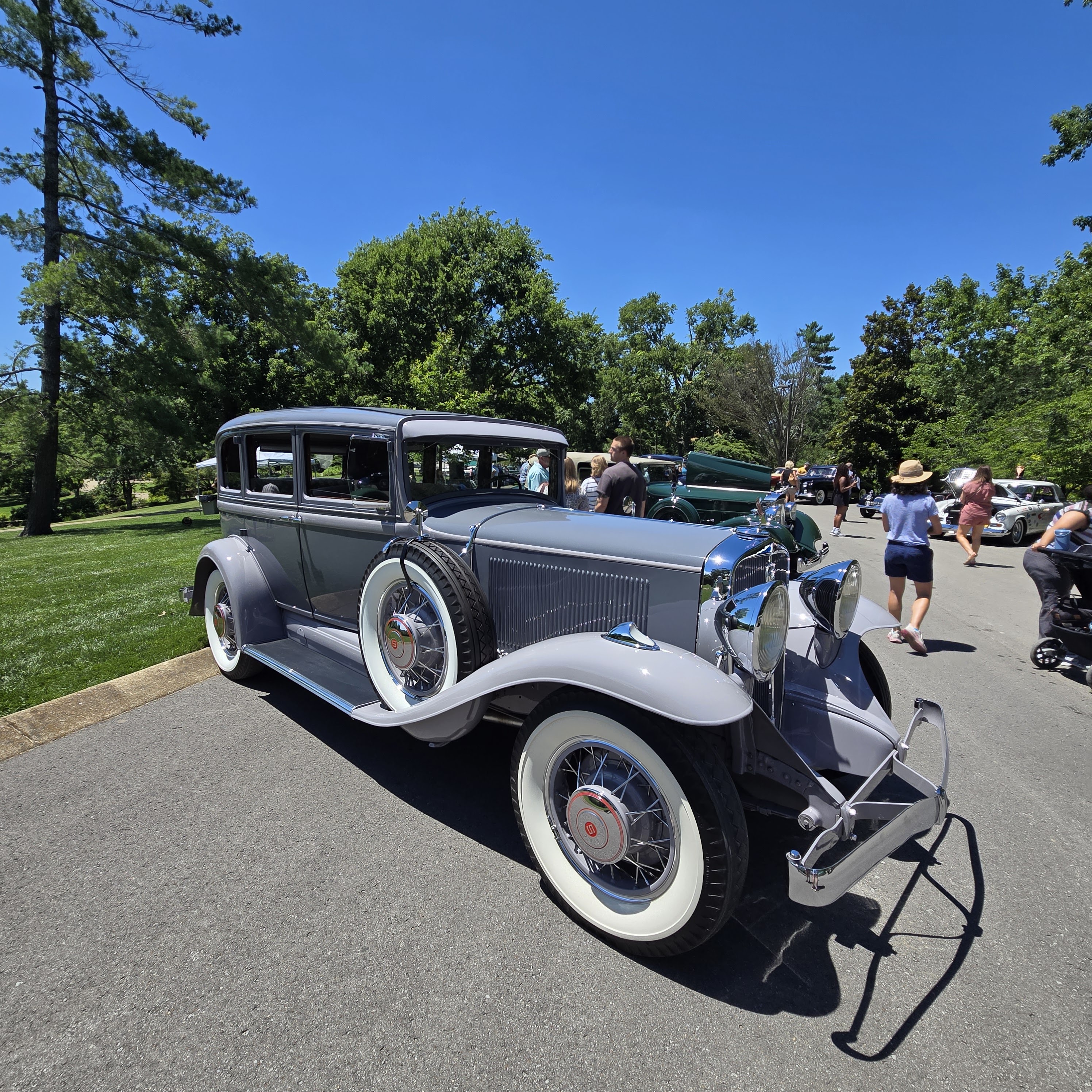
We made our way to Cheekwood Estate and Gardens for their Exposition of Elegance, set against the estate’s gardens instead of a parking lot. It was not as many cars as I expected but what was there was top notch, definitely quality over quantity, and it showed. The Exposition of Elegance has become a Father’s Day weekend tradition that’s grown into one of the more distinctive classic car events in the Southeast. This year’s show brought together more than 65 impeccably preserved automobiles and motorcycles spanning the early to mid-20th century.
The show is closer to a small concours than a typical car meet. Vehicles are curated to reflect the era in which the Cheek family actually lived on the estate, which is part of what gives the event its cohesive, museum feel rather than the usual mixed era cruise in lineup. This year’s field included standouts like a 1920 Rolls-Royce Silver Ghost, a 1938 Packard Twelve Coupe Roadster, and a 1955 Austin-Healey 100M, the kind of cars you’re more likely to see roped off in a museum.
The weekend’s centerpiece is the Lambert Cup, awarded each year to someone who’s spent a career championing automotive history, preservation, and collecting. The award honors Mark Lambert, a longtime concours judge who spent decades helping collectors research, restore, and show their cars, and who judged at events as prestigious as the Pebble Beach Concours d’Elegance. This year’s Lambert Cup went to Mike Wolfe, of History Channel’s American Pickers and owner of Columbia Motor Alley in Columbia, Tennessee a fitting choice for an award built around passion for the hunt as much as the polish.
Something worth mentioning, though it has nothing to do with the cars themselves. Each year Cheekwood commissions a local artist to create commemorative artwork capturing the spirit of that year’s event, available as limited-edition prints and posters. This year’s design came from Nashville native Mattie Ree Neal, whose work has shown at the U.S. Capitol and the Players Club of New York. It’s a nice touch, the kind of small tradition that makes an annual event feel like it’s building its own history one year at a time, not just repeating itself.


Cheekwood itself is worth knowing before you go. The estate was built between 1929 and 1932 as the home of Leslie Cheek and Mabel Wood, who reportedly met on a train ride from New York to Nashville. Architect Bryant Fleming designed the mansion after English country estates, and the couple even traveled to England to source furnishings for the house, filling four railroad boxcars with items shipped back to Nashville. Leslie died just two years after the estate was finished, and Mabel lived there until her death in 1946. Their daughter Huldah later offered the property to become a public botanical garden and art museum, which opened its doors in 1960. Today it spans 55 acres, with 13 distinct gardens and a woodland sculpture trail.
Worth noting if you’re planning a visit: Cheekwood has been at the center of an ongoing zoning dispute with neighbors over a new on-site parking garage, with a lawsuit and appeals still working through Nashville’s zoning board as of this writing. Both sides say they don’t want to see Cheekwood close — the fight is over parking and traffic, not the estate’s future as a destination. It’s still open, still hosting events, and still worth the trip.


If you’re planning a Southern car show weekend, put this one on the list for next year. Cheekwood for the cars, the Frist for art, the Gulch for the walk, and nightlife. Nashville makes it easy to build a weekend around more than just the cars.
Trip Stops,
Leave a Reply