
If you’re a car lover and haven’t made the trip to the corner of Wilshire and Fairfax yet, it needs to go on the list. The Petersen Automotive Museum isn’t just a building full of cool cars it’s the dream and passion project of the man that essentially created the car magazine industry, Robert Petersen.
Car magazines were just part of growing up for me. I was a regular subscriber to Hot Rod and Car Craft, plus Popular Hot Rodding and Street Rodder, although I think those two came from a different publisher. On top of that I had Muscle Mustangs & Fast Fords, Mustang, and Super Ford, along with Motor Trend, Road & Track, and Car and Driver for a stretch. Unfortunately I studied those pages harder than I ever studied for school. Those magazines helped fuel my love of cars and gave me hours of dreaming about having a car like what I saw on those pages. Needless to say I have wanted to visit The Petersen for as long as its been open, it wasn’t just walking into a car museum it was walking into a Car Guy’s dream.


The Petersen exists because a magazine publisher refused to let his dream of a museum stay a dream. In 1994, Robert Petersen and his wife Margie made it official, donating millions to launch the museum as a branch of the Natural History Museum of Los Angeles County. Six years later, they gave millions more so the Petersen could break off and stand on its own as an independent nonprofit, their combined giving topped $30 million, among the largest single gifts any museum in the country has received.


You can’t tell the Petersen’s story without understanding who Robert Petersen was, because the museum is really just the final chapter of a life that was already improbable by the time he built it.
He was born Robert Einar Petersen in East Los Angeles in 1926, the son of a truck mechanic, which is where he picked up his first real feel for cars. He didn’t come from money or connections by his own description, he was just a “kid from Barstow.” He dropped out of high school in his teens and worked odd jobs, including pumping gas, before landing a spot in the publicity department at MGM Studios. That job is really where the whole thing started, it put him around promotion and media at a young age, and gave him the instincts he’d need later.
In the late 1940s, Petersen was working to promote a hot rod exhibition in Los Angeles when he noticed something obvious in hindsight but invisible at the time. There was no magazine covering hot rodding at all, even though the scene around the dry lake beds of the Mojave was clearly building into something real. He borrowed $400, teamed up with fellow promoter Bob Lindsay, and put out the first issue of Hot Rod magazine in January 1948. That first run was 5,000 copies, typewritten and rough around the edges, sold by hand at the steps of the very exhibition he’d been hired to promote. Within about a year, monthly sales had passed 50,000.
Hot Rod is generally recognized as the magazine that kicked off car enthusiast publishing as its own category, before that there just wasn’t a magazine built around the hobby itself. Every title that followed, including plenty of the ones on my own subscription list growing up, was in some way following the lane Petersen carved out first.


Hot Rod was just the opening move. In 1949 Petersen launched Motor Trend, reportedly shooting the first cover photo himself and kept building from there, eventually growing Petersen Publishing into a company with more than two dozen titles, including Car Craft and Motorcyclist alongside non-automotive titles that took his business well beyond the garage. Along the way he also co-founded SEMA, the Specialty Equipment Market Association, cementing his role as one of the people who professionalized car culture rather than just chronicled it.
By the time he and his wife Margie turned to museum building in the 1990s, Petersen had spent nearly five decades embedded in the world he was about to enshrine. That’s really what separates the Petersen from a lot of car museums it wasn’t built by an outside collector or a corporation. It was built by the guy who’d been in the room, on the dry lake beds and at the magazine stands, since the hobby was still considered a fringe pursuit for California kids. He passed away in 2007, but the museum remains the clearest physical expression of what he spent his career arguing, that car culture deserved to be taken seriously.


The building has its own history that mirrors the cars inside it. It started life as a department store in the early 1960s, went dark in the mid ’80s, and sat empty until Petersen saw potential in it mainly because it had almost no windows, which meant the collection could sit under museum lighting without sun damage doing slow, quiet destruction to the paint and upholstery.
The first renovation leaned hard into a car inspired, space-age design style, sharp angles, fins, the kind of look that feels like it drove straight out of a 1960s gas station sign. Then in 2015, the museum went through a massive redesign that gave it the stainless-steel ribbon exterior it’s known for today, engineered to evoke motion and speed wrapping around the whole structure. Love it or find it a little much, you can’t drive past it and not look.


The galleries rotate constantly, which is part of why the Petersen rewards repeat visits instead of a one and done trip. Expect race cars, motorcycles, concept vehicles that never made it to production, and a steady stream of cars that crossed over into pop culture, movie cars, celebrity-owned cars, the kind of stuff that makes non car-people stop and take a photo too.
There’s also a hands-on science floor built for kids, which is a smart move for a museum trying to build the next generation of enthusiasts, not just cater to the ones who already know a flathead from a mouse motor.


Our visit happened to line up with “Totally Awesome! Cars and Culture of the ’80s and ’90s,” and it was a genuinely fun to walk into, especially being a child of the ’80s. This one leans all the way in it’s not just cars parked under placards, it’s a full sensory throwback to the decade, right down to the synth soundtrack playing overhead. Think swoopy spoilers, digital dashboards, and the kind of angular, “designed on a computer for the first time” styling that only the ’80s could produce.
The star of the show is a Lamborghini Countach, the poster car that basically invented the idea of a car poster and the exhibit doesn’t stop at the cars themselves. There are video games, movie and TV tie-ins (think Back to the Future and Knight Rider territory), and fashion pulled straight from the era, all used to explain why these cars looked and felt the way they did. If you grew up with a poster of one of these on your wall, or your parents did, it hits different in person than it does in photos.


The other special exhibit during our visit was “People’s Champ: The Impact of Ken Block” a tribute to the late rally driver, Hoonigan founder, and Gymkhana mastermind who redefined what automotive content could look like online before his death in 2023.
This one’s built for the enthusiast crowd. Nine of Block’s actual vehicles were on display, spanning his rally cars, rallycross builds, and some of the purpose-built machines from the Gymkhana series.
Beyond the cars, the exhibit dug into Block’s whole story, racing suits, helmets, DC Shoes collabs (he co-founded the brand), and Hoonigan merchandise tracing his path from modified street cars to the purpose built monsters that racked up hundreds of millions of views. It’s a genuinely moving tribute if you followed his career, and a great intro if you didn’t.


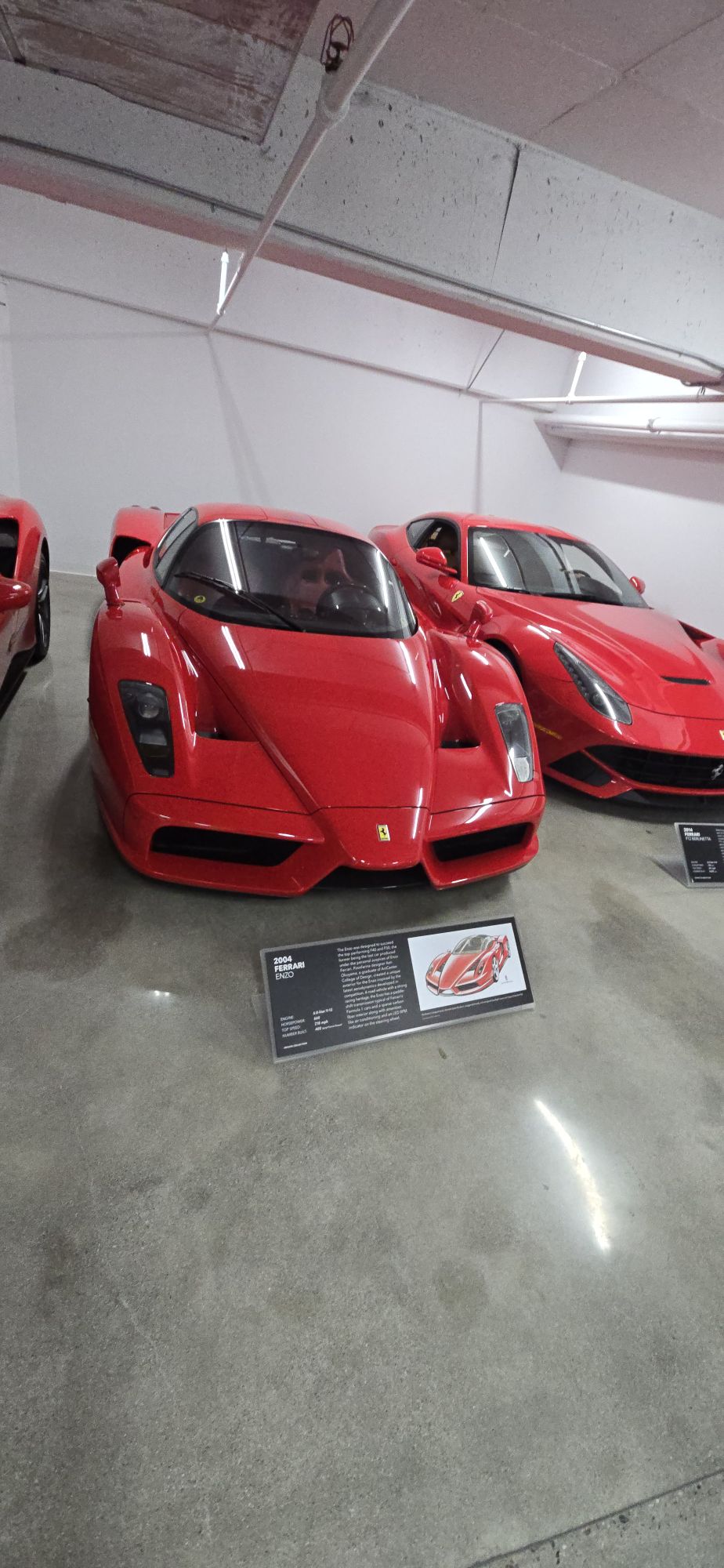
We also sprang for The Vault, and if you only do the main galleries, you’re missing half the museum. This is the below ground, climate controlled storage level where the Petersen keeps everything that isn’t currently in rotation upstairs. Holding 300 plus vehicles spanning roughly 120 years of automotive history.


The vibe down there is completely different from the galleries above. Upstairs is curated and staged, with placards and lighting built around a story. The Vault feels more like walking through the world’s best kept warehouse, cars parked close together, packed in rows, way less produced. That’s exactly what makes it worth doing. You can walk past celebrity-owned cars, award-winning hot rods, and prototypes that never made it to production, and yeah, there were a handful of cars down there I couldn’t have told you a thing about. It’s less “exhibit” and more “raw collection,” and it makes you feel like you got a peek at something most visitors don’t bother with.


A few things to know before you go, it’s a separate, ticketed add on to general admission (you need general admission to get in), it’s a guided visit, strollers and kids under 10 aren’t allowed, and it genuinely takes close to 90 minutes to see properly so don’t try to squeeze it in right before closing.

For SMS, the Petersen is a natural stop, not just a detour. It’s proof that car culture isn’t only lived on the open road it’s also preserved, curated, and celebrated in a building that treats automobiles as legitimate design and cultural artifacts, on par with anything you’d find in an art museum. If your trip route touches LA, this is worth carving out a half day easily.
Practical info:
6060 Wilshire Blvd, Los Angeles, CA 90036
Sits at one of the busiest intersections in the city, so plan parking accordingly
The main galleries and The Vault are ticketed separately — decide ahead of time if you want the full experience
Exhibits rotate, so check the current lineup before your visit — “Totally Awesome!” and the Ken Block tribute won’t be up forever, but something equally worth the trip usually is
Have you been? Save this one for your next West Coast route, or drop a comment if you’ve already made the trip — we want to hear which car in the collection stopped you in your tracks.
Leave a Reply